The baghouse vs cartridge dust collector decision shapes whether your combustible dust collection system meets NFPA 660 requirements or creates compliance gaps that insurance auditors flag. Your choice determines explosion protection costs, floor space needs, and long-term operating expenses.
Key Takeaways:
- Cartridge collectors require 60-70% less floor space than baghouse systems but cost 15-25% more per CFM of capacity
- Baghouse collectors handle St-3 combustible dusts better due to stronger housing construction and larger explosion vent areas
- Installation costs for explosion protection add $8,000-$15,000 to cartridge systems vs $12,000-$25,000 to baghouse systems
Baghouse vs Cartridge Collector: Which Handles Combustible Dust Better?
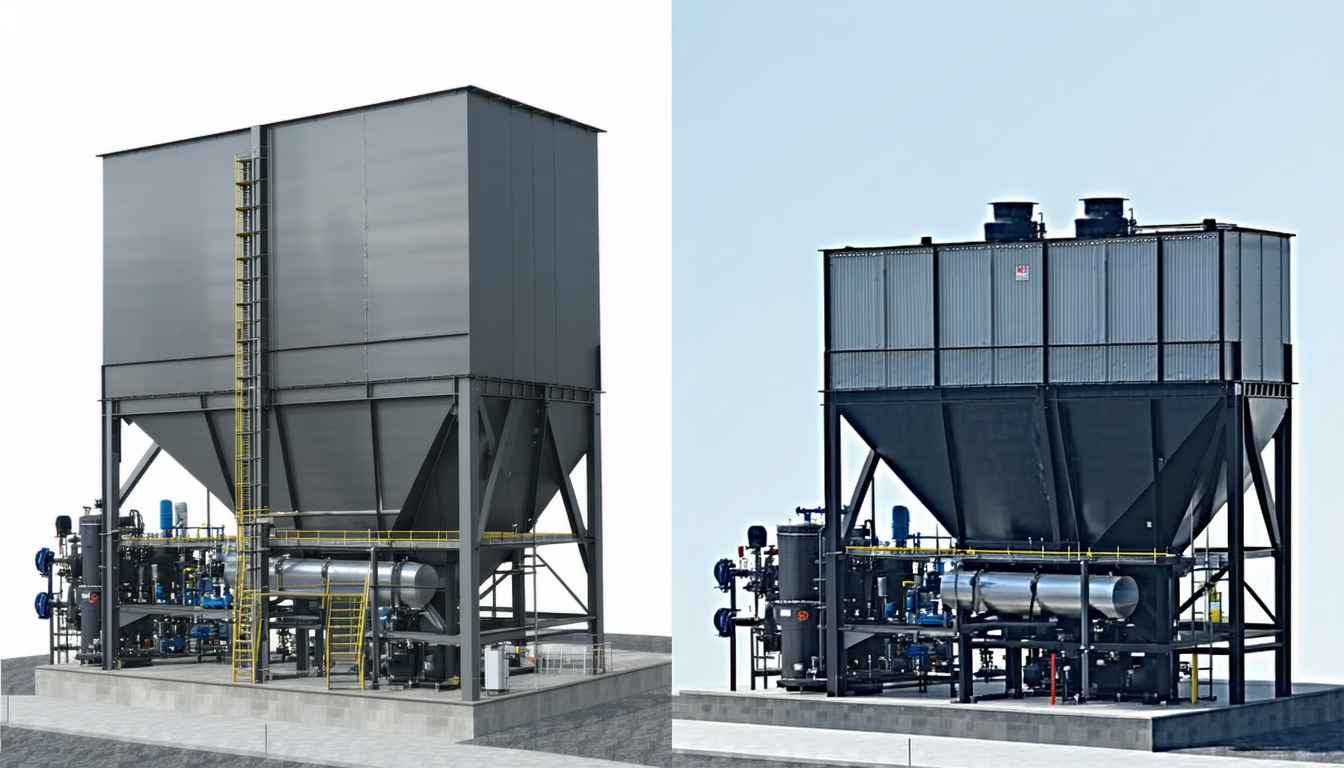
Baghouse collectors handle higher Kst values than cartridge systems. The difference comes down to housing strength and geometry.
Cartridge collectors excel at fine particle capture but struggle with highly explosive dusts. Their compact design creates higher internal pressures during deflagration events. Most cartridge units max out at St-2 classification dusts with Kst values under 300 bar-m/s.
Baghouse systems typically handle St-3 dusts (Kst >300) without structural modifications. Their larger housing volume and reinforced construction absorb explosion pressures better. The fabric filter design also provides more uniform pressure distribution across the collector body.
| Feature | Baghouse Collector | Cartridge Collector | Kst Compatibility |
|---|---|---|---|
| Maximum Kst Rating | 500+ bar-m/s (St-3) | 300 bar-m/s (St-2) | Baghouse handles higher classifications |
| Housing Pressure Rating | 2.5-4.0 psig standard | 1.5-2.5 psig standard | Baghouse provides stronger containment |
| Explosion Vent Area Required | 15-20% larger panels | Standard panel sizing | Baghouse needs more vent capacity |
| Structural Reinforcement Cost | $3,000-$8,000 for St-3 | $8,000-$15,000 for St-2+ | Cartridge requires more modification |
NFPA 660 Section 7.1.2 requires dust collection systems to withstand the maximum expected explosion pressure for your specific dust type. If your dust hazard analysis shows St-3 classification, cartridge collectors need expensive structural upgrades while baghouse systems often meet requirements with minimal modification.
The housing geometry also affects cleaning effectiveness with combustible dusts. Baghouse filters use lower-pressure pulse cleaning that generates less static electricity buildup. Cartridge systems use high-pressure reverse pulse cleaning that can create ignition sources in sensitive dust environments.
Filtration Efficiency: Baghouse vs Cartridge Performance Comparison
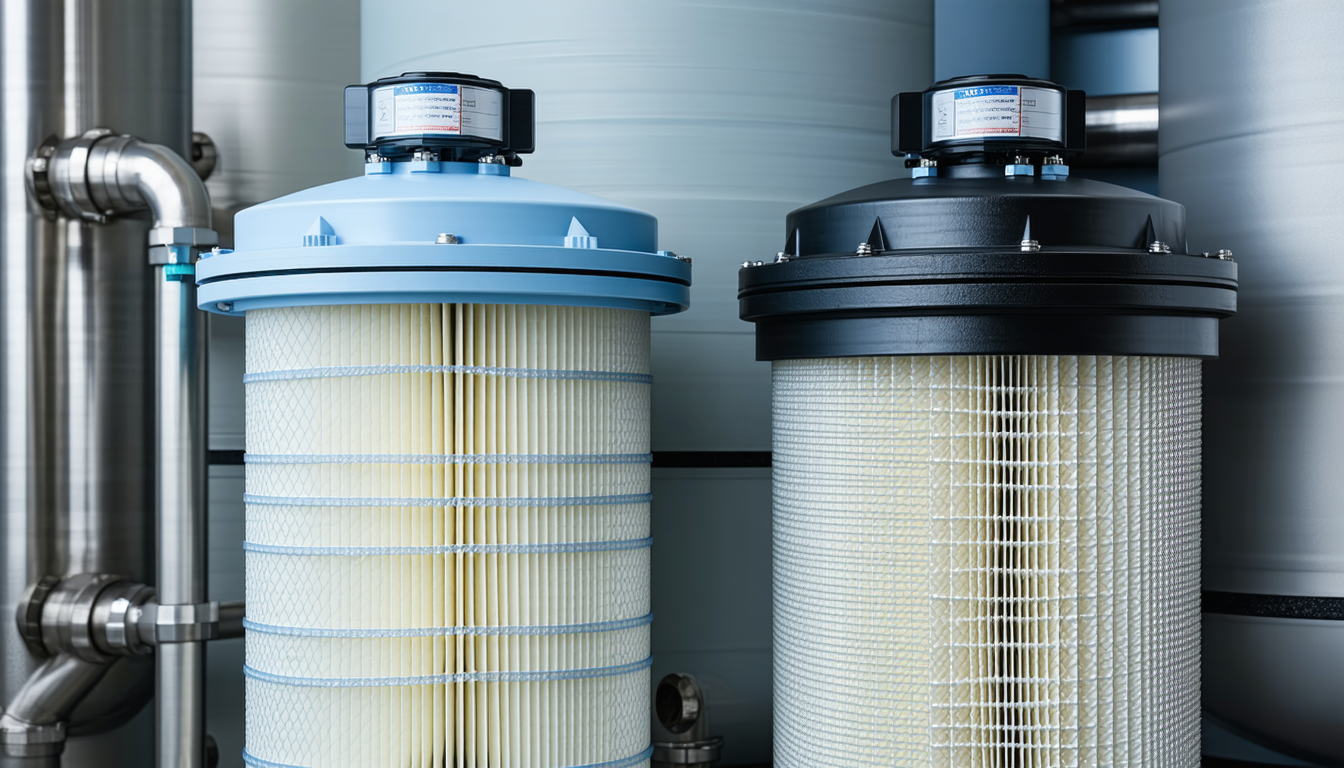
Cartridge filters achieve 99.97% efficiency at 0.5 microns. Baghouse systems reach 99.5% efficiency for the same particle size. The difference matters for regulatory compliance and transport velocity calculations.
Cartridge collectors use pleated media with 40-60 square feet of filter area per cartridge. This high surface area density captures fine particles more effectively than woven baghouse fabrics. The pleated design creates tortuous airflow paths that force particles into contact with filter media.
However, baghouse systems handle higher dust loadings without efficiency degradation. Their smooth fabric surface sheds dust cakes more completely during pulse cleaning. Cartridge pleats trap particles in corners where cleaning air cannot reach.
| Feature | Baghouse System | Cartridge System | Transport Velocity Impact |
|---|---|---|---|
| Particle Efficiency (0.5 micron) | 99.5% | 99.97% | Cartridge allows lower velocities |
| Pressure Drop (clean) | 2-4 inches WC | 1-3 inches WC | Cartridge reduces fan power |
| Dust Loading Capacity | 50-200 grains/ft³ | 20-80 grains/ft³ | Baghouse handles higher concentrations |
| Cleaning Effectiveness | 95-98% cake removal | 85-92% cake removal | Baghouse maintains consistent flow |
Transport velocity requirements drop when collectors maintain higher efficiency. Cartridge systems can operate with 15-20% lower duct velocities because they capture more particles on the first pass. This reduces ductwork size and fan horsepower requirements.
The cleaning cycle frequency affects efficiency over time. Cartridge collectors pulse every 30-60 seconds to maintain low pressure drop. Baghouse systems pulse every 2-5 minutes, allowing dust cakes to build and improve filtration before cleaning.
How Do Explosion Protection Requirements Differ Between Collector Types?
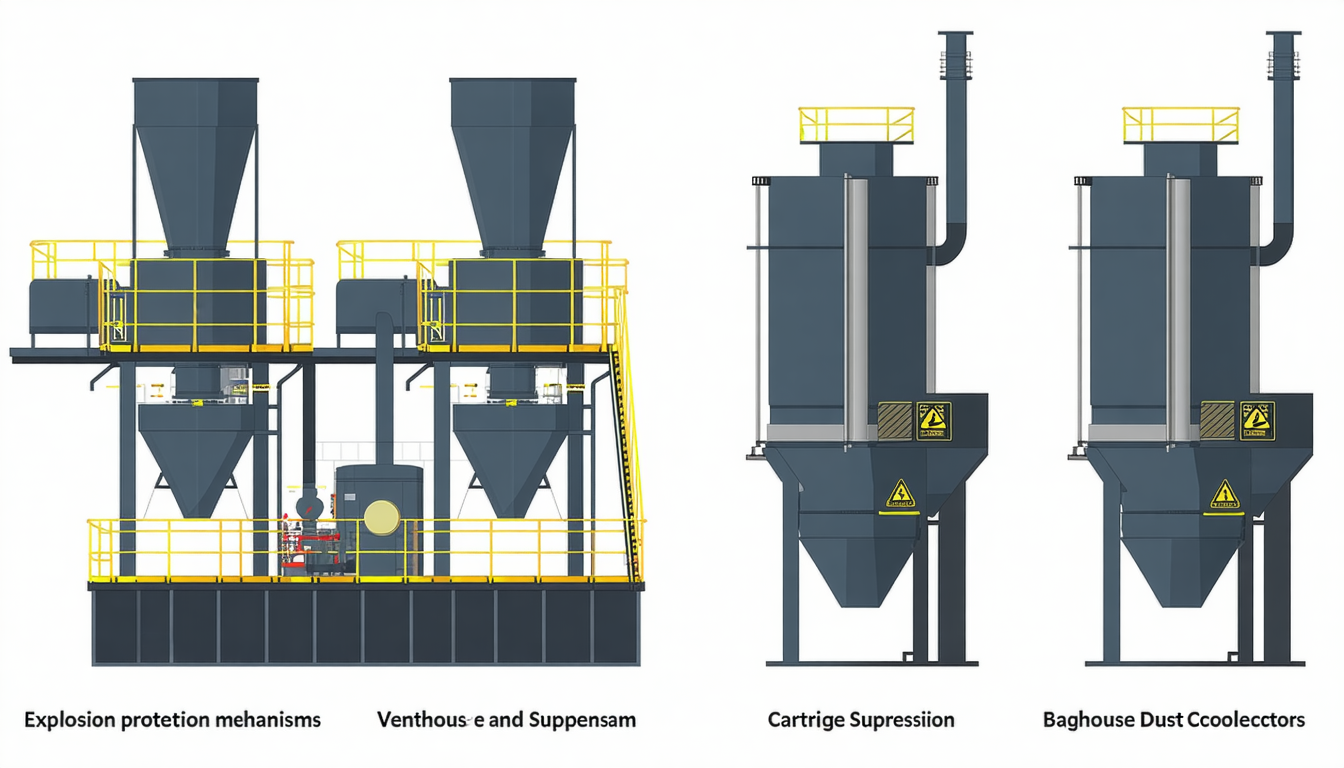
NFPA 660 requires different explosion protection based on collector housing design. The integration complexity and costs vary significantly between baghouse and cartridge systems.
Explosion protection integration differs in four key areas:
Vent panel mounting options – Baghouse collectors offer multiple mounting surfaces on their larger housings, while cartridge collectors have limited flat areas for vent panel installation. Baghouse systems typically mount panels on the clean air plenum, dirty air chamber, or side walls. Cartridge units often require custom mounting brackets.
Suppression system compatibility – Chemical suppression systems integrate easier with baghouse collectors because their larger internal volume provides better agent distribution. Cartridge collectors need multiple injection points due to compartmentalized design. Suppression activation time increases from 50-80 milliseconds for baghouse to 80-120 milliseconds for cartridge systems.
Isolation valve requirements – Both collector types need isolation valves in inlet ductwork, but cartridge systems require closer valve placement due to their compact size. NFPA 660 Section 8.4.1 mandates valve activation within 25 milliseconds. Baghouse systems can place valves 15-20 feet upstream, while cartridge collectors need valves within 8-10 feet of the inlet.
Compliance verification steps – Baghouse systems require 15-20% larger vent panel area due to housing geometry creating higher internal pressures. Verification testing costs average $5,000-$8,000 for baghouse vs $3,000-$5,000 for cartridge systems due to the additional vent area calculations.
The larger vent requirements for baghouse collectors increase material costs but simplify installation. Standard vent panels work without custom sizing calculations that cartridge systems often require.
Space Requirements and Installation Footprint Analysis
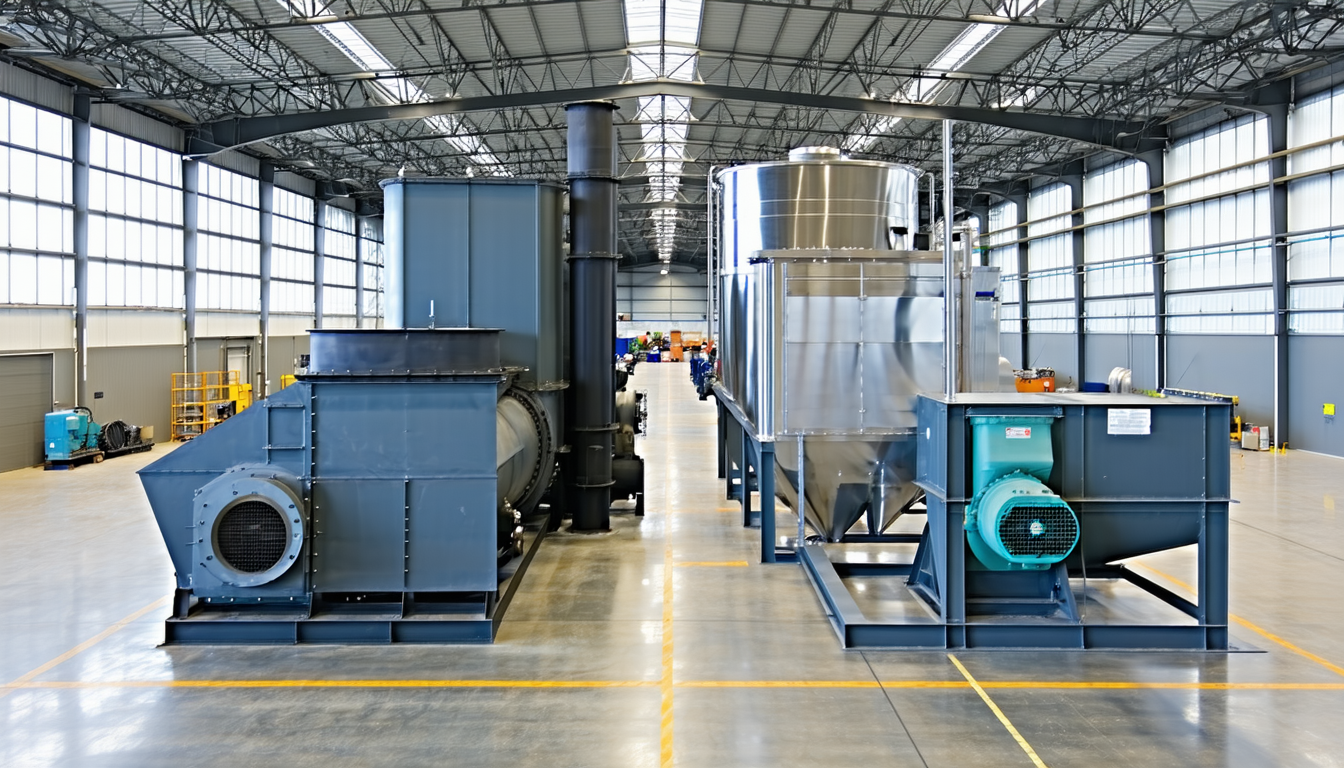
Cartridge collectors require 60-70% less floor space than equivalent baghouse systems. The space savings come from vertical filter arrangement and compact housing design.
A 10,000 CFM cartridge collector measures approximately 8×15 feet, requiring 120 square feet of floor space. An equivalent baghouse system measures 12×25 feet, needing 300 square feet. The height difference is less dramatic – cartridge units stand 18-22 feet tall while baghouse systems reach 16-20 feet.
| Feature | Space Category | Baghouse Collector | Cartridge Collector |
|---|---|---|---|
| Floor Space (10,000 CFM) | Primary footprint | 300 sq ft | 120 sq ft |
| Maintenance Access | Additional clearance | 150 sq ft | 80 sq ft |
| Ductwork Routing | Connection space | 100 sq ft | 60 sq ft |
| Explosion Protection | Equipment clearance | 75 sq ft | 45 sq ft |
| Total Footprint | Complete installation | 625 sq ft | 305 sq ft |
Maintenance access requirements add significant space to both systems. Baghouse collectors need 4-6 feet clearance on the bag access side for filter changeouts. Cartridge collectors require 3-4 feet clearance but need overhead access for cartridge removal, limiting installation options in buildings with low ceilings.
Ductwork routing affects installation space differently. Baghouse systems typically have inlet and outlet connections on opposite ends, requiring straight-line ductwork runs. Cartridge collectors often have top inlet and side outlet configurations, allowing more flexible ductwork routing in tight spaces.
Explosion protection equipment adds space requirements for both collector types. Vent panels need clear discharge areas extending 15-20 feet from the collector. Suppression system components require access for maintenance and cylinder replacement.
Total Cost of Ownership: 10-Year Financial Comparison
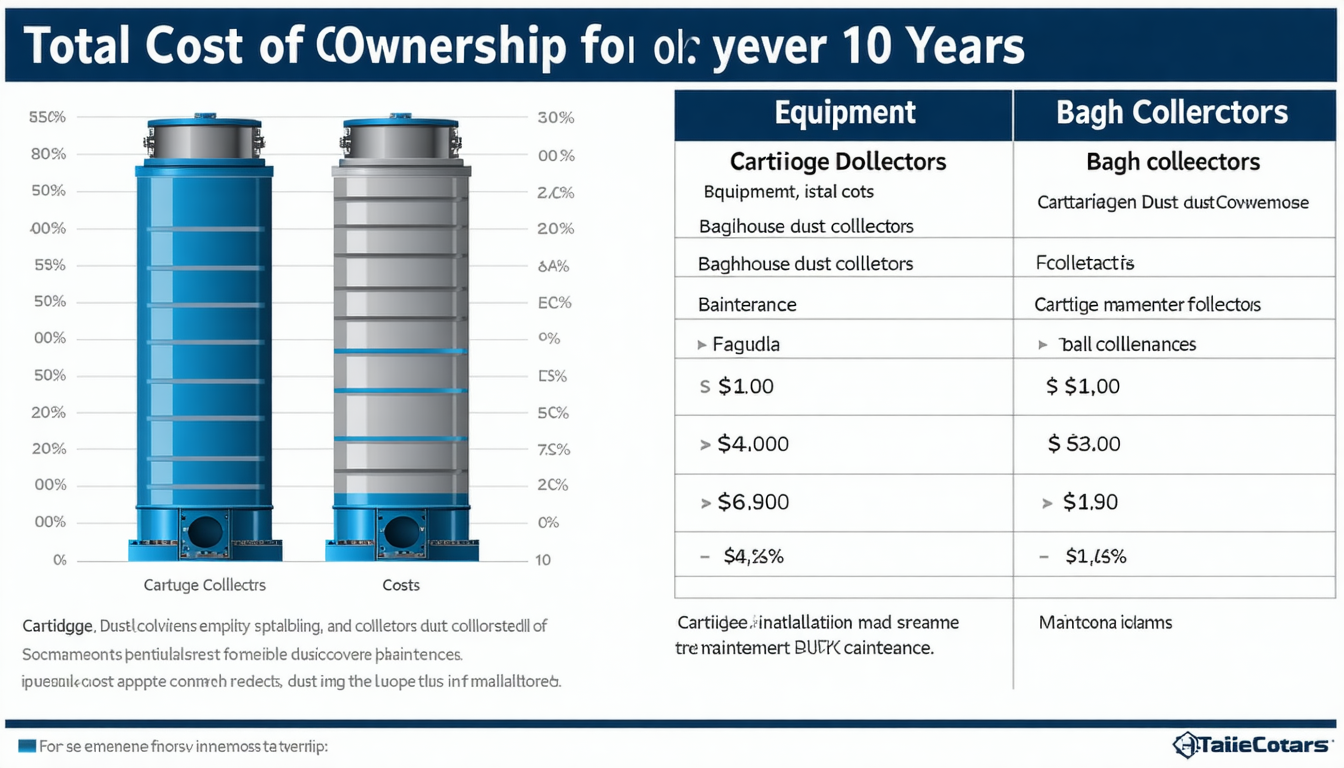
Total cost of ownership includes equipment, installation, media replacement, and energy costs. The financial picture shifts dramatically when you account for all expense categories over 10 years.
Cartridge collectors cost 15-25% more upfront per CFM of capacity. A 10,000 CFM cartridge system costs $85,000-$95,000 versus $65,000-$75,000 for an equivalent baghouse collector. However, installation costs favor cartridge systems due to their compact size.
| Feature | Cost Category | Baghouse Collector | Cartridge Collector |
|---|---|---|---|
| Equipment Cost (10,000 CFM) | Initial purchase | $65,000-$75,000 | $85,000-$95,000 |
| Installation Labor | Setup and connections | $25,000-$35,000 | $18,000-$25,000 |
| Explosion Protection Add-on | Venting and isolation | $12,000-$25,000 | $8,000-$15,000 |
| Filter Media (Annual) | Replacement costs | $9,000 (bags every 3 years) | $24,000 (cartridges annually) |
| Energy Consumption (Annual) | Fan power at 6¢/kWh | $8,500 | $6,800 |
| 10-Year Total | Complete ownership | $232,000-$285,000 | $291,000-$338,000 |
Cartridge media replacement costs average $2.40 per CFM annually versus $0.90 per CFM for baghouse media. This difference compounds over time. Cartridge filters last 6-18 months in combustible dust service due to frequent pulse cleaning cycles. Baghouse filters operate 2-5 years before replacement.
Energy consumption favors cartridge systems. Their lower pressure drop reduces fan horsepower by 15-20%. Annual energy savings of $1,700 per 10,000 CFM offset some of the higher media costs but never overcome the total gap.
Maintenance labor costs run similar for both systems. Cartridge replacement takes 2-4 hours per changeout but happens more frequently. Baghouse media replacement requires 6-8 hours but occurs less often. The annual maintenance hours average 12-15 for cartridge systems versus 8-12 for baghouse collectors.
Explosion protection integration costs favor cartridge systems initially but baghouse systems over time. Cartridge collectors need smaller vent panels and suppression systems, reducing upfront costs. However, their more complex integration requires more frequent inspection and testing.
Which Collector Type Should You Choose for Your Combustible Dust Application?
Collector selection depends on dust classification, space constraints, and budget priorities. Follow this decision framework to determine the optimal choice for your specific application.
Use this step-by-step evaluation process:
Assess your dust classification first – Review your dust hazard analysis results for Kst values and explosion class. If testing shows St-3 classification (Kst >300), choose baghouse collectors. They handle high-energy dusts without expensive structural modifications. Cartridge systems struggle with St-3 dusts and require costly reinforcement.
Evaluate available floor space – Measure your installation area and compare it to collector footprint requirements. If floor space is limited (under 400 square feet available), cartridge collectors provide the only viable option. Their 60-70% smaller footprint fits where baghouse systems cannot.
Calculate 10-year operating costs – Factor in media replacement frequency, energy consumption, and maintenance labor. Baghouse systems cost $50,000-$75,000 less over 10 years due to longer filter life. Choose baghouse if minimizing operating expenses is the priority.
Consider installation timeline and complexity – Cartridge collectors install faster due to compact size and simpler ductwork connections. If minimizing production downtime during installation is critical, cartridge systems offer 2-3 day faster startup.
Verify NFPA 660 compliance requirements – Confirm explosion protection integration costs and complexity for your facility. Baghouse systems offer simpler vent panel mounting and suppression integration. Choose baghouse if your facility lacks expertise for complex explosion protection systems.
Match collector capacity to transport velocity needs – Calculate minimum duct velocities required to prevent dust settling. Cartridge collectors allow 15-20% lower transport velocities due to higher filtration efficiency, reducing ductwork size and fan power requirements.
Facilities with St-3 dusts and unlimited floor space should choose baghouse systems 85% of the time based on lifecycle costs. The combination of lower operating expenses and simpler explosion protection integration outweighs the larger footprint requirement.
Frequently Asked Questions
Can you use the same explosion protection system on both baghouse and cartridge collectors?
Explosion venting and suppression systems work on both collector types, but sizing and mounting requirements differ. Cartridge collectors need smaller vent areas due to compact housing geometry, while baghouse systems require larger panels but offer more mounting options. The protection principles remain the same, but implementation details change based on collector design.
Do cartridge collectors last longer than baghouse systems for combustible dust applications?
Cartridge collectors typically have shorter media life in combustible dust service due to more frequent pulse cleaning cycles. Filter cartridges last 6-18 months versus 2-5 years for baghouse media, but cartridge housings generally outlast fabric housings by 5-10 years. The housing longevity advantage rarely offsets the higher media replacement frequency and costs.
Which collector type is easier to retrofit with explosion protection?
Baghouse collectors are typically easier to retrofit because their larger housing provides more mounting options for vent panels and suppression equipment. Cartridge collectors often require structural modifications to accommodate explosion protection systems. The retrofit complexity increases project costs by 20-40% for cartridge systems compared to baghouse installations.