
Wood dust explosion risks killed 14 workers in the 2003 West Pharmaceutical disaster, proving that sawdust creates the same lethal conditions as grain powder. Cabinet shops and furniture manufacturers face specific combustible dust requirements under NFPA 660 Chapter 24.
Key Takeaways:
- NFPA 660 Chapter 24 applies to woodworking facilities over 5,000 square feet and prohibits PVC ductwork for all wood dust collection systems
- MDF and particle board dust creates 40% higher explosion pressures than hardwood dust due to resin binder content
- Cabinet shops and furniture manufacturers can use enclosureless collectors only if wood dust quantity stays below 10 cubic feet and system weight remains under 1,320 pounds
Is Wood Dust Actually Combustible and Explosive?

Combustible dust is any finely divided solid material with particle sizes under 420 microns that can create an explosion when suspended in air and ignited. This means wood dust from sanding, sawing, and routing operations meets the technical definition of a combustible dust hazard.
Wood dust Kst values range from 100-300 bar-m/s depending on species and moisture content. Pine dust typically measures 150-200 bar-m/s, while oak and maple range from 180-250 bar-m/s. These material Kst profile numbers place wood dust in the same explosion severity class as grain dust and many chemical powders.
Particle size determines explosion risk more than wood species. Orbital sanders and planers generate particles between 10-100 microns, the size range with maximum surface area exposure to oxygen. Chainsaw operations produce larger chips that pose minimal explosion risk, but dust collection systems capture the fine fraction that creates the hazard.
The “natural material” misconception kills people. Wood dust suspended in air at concentrations between 40-60 grams per cubic meter will explode when ignited. A single spark from static electricity or hot bearing can trigger deflagration that destroys buildings and kills workers.
NFPA 660 Chapter 24: Woodworking Industry Requirements
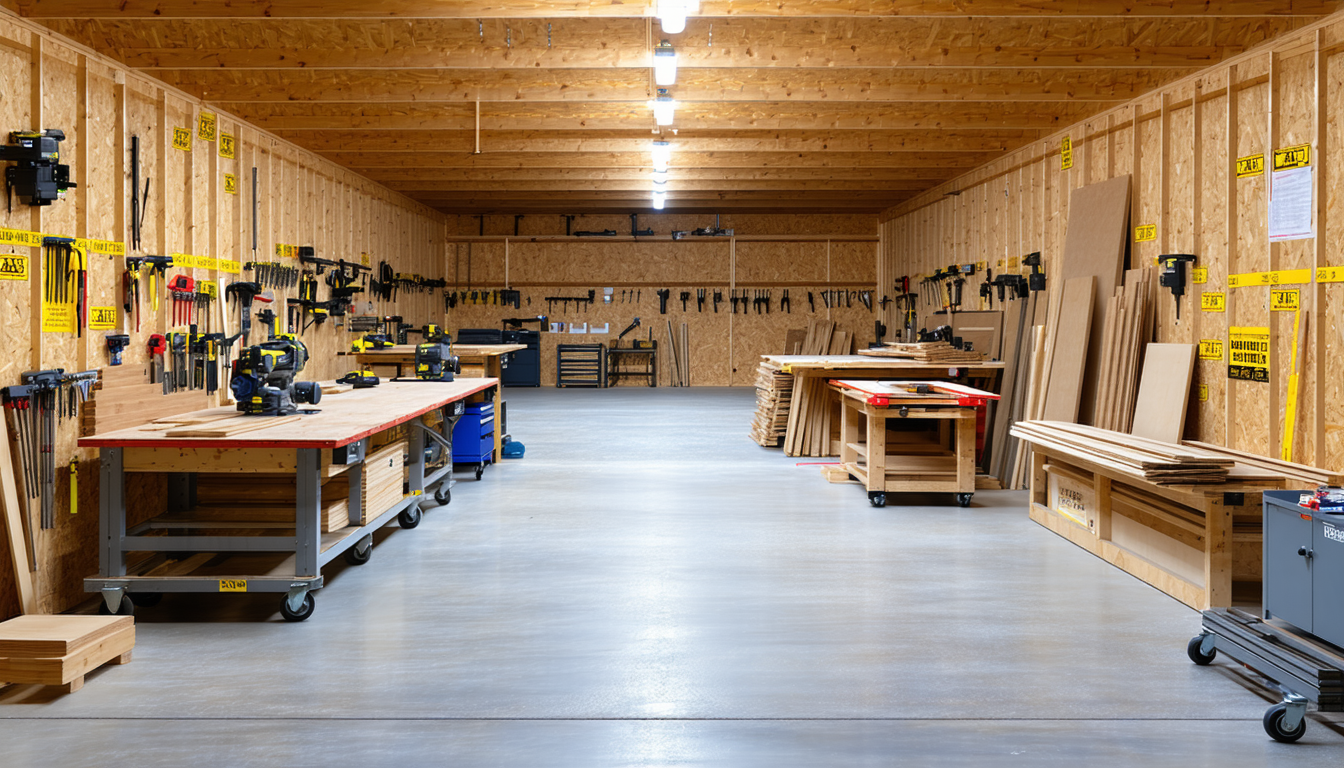
NFPA 660 Chapter 24 specifies woodworking compliance requirements that differ from general combustible dust provisions. Facilities under 5,000 square feet follow Chapter 25 general requirements instead of woodworking-specific provisions.
| Requirement | NFPA 660 Chapter 24 |
|---|---|
| Facility size threshold | 5,000 square feet minimum |
| Ductwork material | Metal only, no PVC or plastic |
| Dust collection grounding | Required for all metallic components |
| Enclosureless collector limit | 1,320 pounds total weight |
| Dust capacity restriction | 10 cubic feet maximum |
| Explosion protection | Required for enclosed collectors |
Chapter 24 addresses specific woodworking hazards that general provisions miss. Section 24.3.1 prohibits PVC ductwork because wood dust transport generates static electricity that ignites accumulated dust. Section 24.4.2 allows enclosureless collectors only when total system weight stays under 1,320 pounds and dust capacity remains below 10 cubic feet.
The vertical compliance requirement means cabinet shops cannot simply follow generic dust collection guidelines. Chapter 24 recognizes that wood processing creates unique particle size distributions and static generation patterns that require specialized controls.
Facilities expanding beyond 5,000 square feet trigger Chapter 24 compliance even if existing systems worked under general requirements. The industry-specific chapter applies to the entire facility, not just the expanded area.
Why PVC Ductwork Is Prohibited for Wood Dust Collection
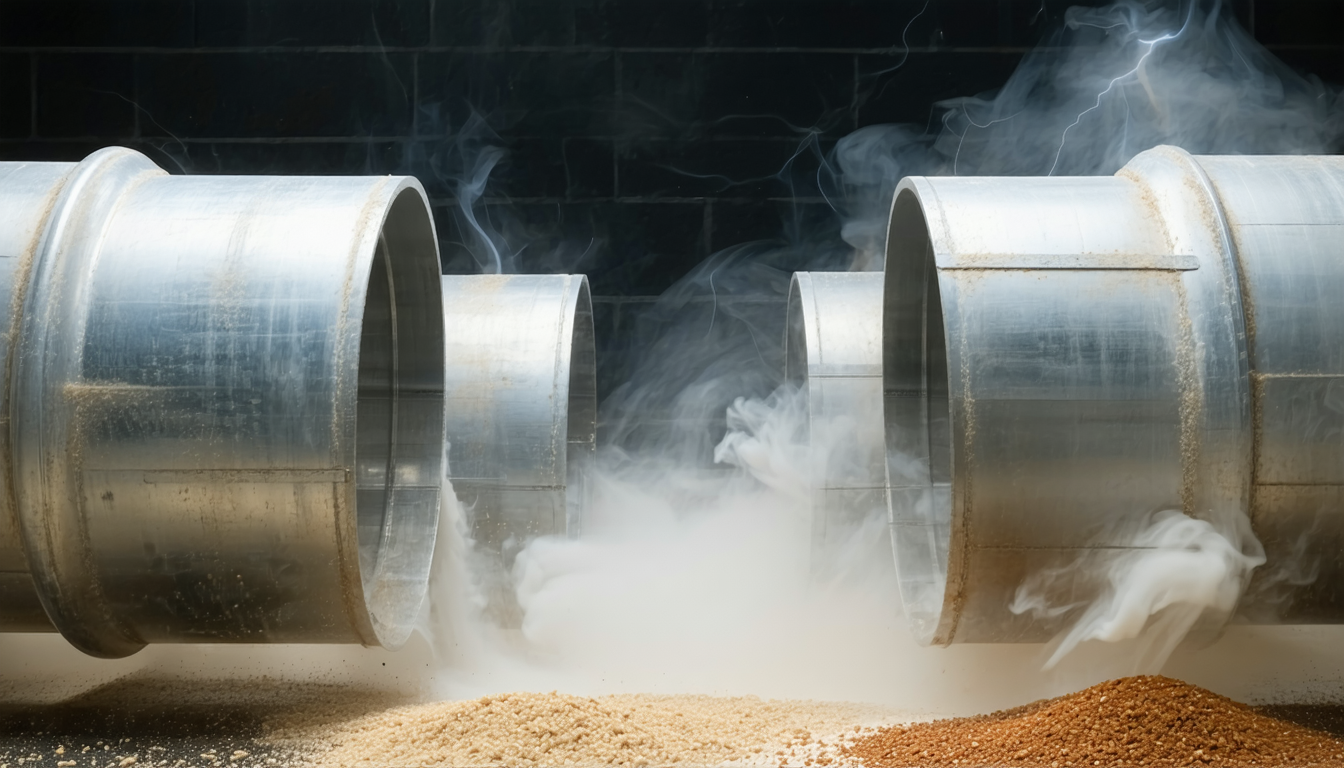
PVC ductwork generates static electricity ignition risk when wood dust travels through the system at typical transport velocities. Static charges build as particles rub against plastic surfaces, creating potential differences that can exceed 30,000 volts.
NFPA 660 Section 9.2.3 prohibits non-conductive ductwork materials for combustible dust transport. The standard requires metal ductwork with proper grounding and bonding to dissipate static charges before they reach ignition levels.
Wood dust transport velocities between 3,500-4,500 feet per minute create maximum static generation in PVC systems. The triboelectric effect, charge transfer from friction, becomes severe when dry wood particles contact plastic surfaces at high speed.
Metal ductwork grounding requirements add installation complexity but prevent static ignition sources. Each duct section must connect electrically to create a continuous path to ground. Flanged connections need bonding jumpers across gaskets that might interrupt electrical continuity.
The cost impact of PVC prohibition forces many shops to redesign existing systems. Galvanized steel ductwork costs 40-60% more than PVC but eliminates the static generation that triggers most dust collection system explosions.
Wood Dust Explosion Risk Factors in Cabinet Shops

Cabinet shop operations create specific explosion risk patterns that differ from other woodworking processes:
Orbital sanding operations generate 85% of particles under 75 microns, the size range with highest explosion risk. Belt sanders produce coarser dust with lower surface area ratios.
Router and shaper work creates fine dust clouds that remain suspended longer than sawing operations. The high-speed cutting action pulverizes wood fibers into explosion-prone particle sizes.
MDF and engineered lumber processing increases dust reactivity compared to solid wood operations. Formaldehyde resins in these materials boost explosion pressures by 25-40% over hardwood dust.
Multiple species mixing complicates testing because different woods have different Kst values. A shop processing both pine and oak needs testing that represents the worst-case mixture.
Finishing operations introduce solvent vapors that lower ignition energy requirements. Even small amounts of lacquer thinner or acetone mixed with wood dust create Class I/Division 1 electrical classification requirements.
Dust accumulation in elevated areas creates secondary explosion risks when primary deflagration displaces settled dust. Cabinet shops with overhead storage and mezzanines face higher secondary explosion potential.
Enclosureless Dust Collector Requirements for Woodworking
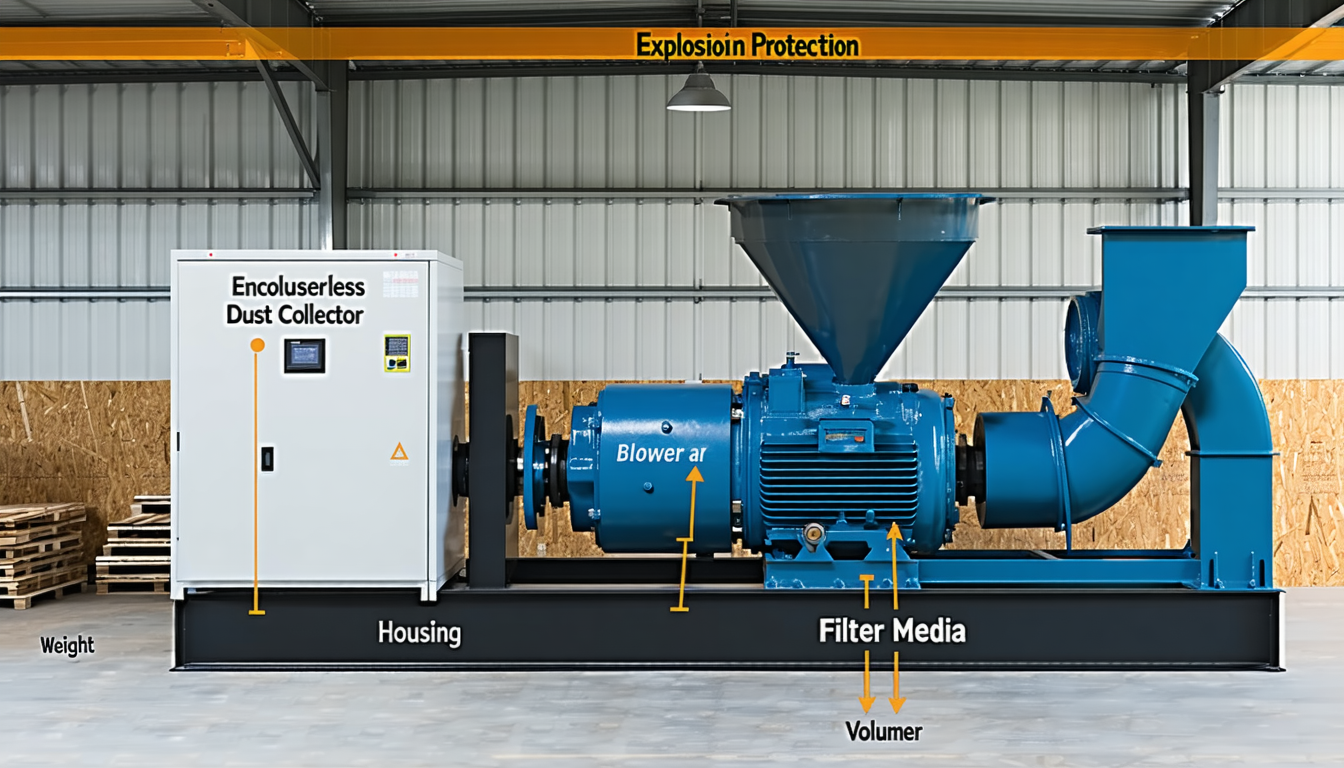
Enclosureless collectors require specific weight and volume limits that disqualify most cabinet shop applications:
Calculate total system weight including collector housing, filter media, blower, and motor assembly. Systems exceeding 1,320 pounds must use enclosed collector designs with explosion protection.
Measure dust holding capacity in the collection chamber and any hoppers or drums. Total volume cannot exceed 10 cubic feet of collected wood dust at any time.
Verify wood-only material streams because mixed combustible dusts disqualify enclosureless systems. Shops processing metal, plastic, or composite materials cannot use enclosureless designs.
Install at ground level with direct outdoor discharge. Enclosureless collectors cannot connect to ductwork systems or discharge into buildings.
Maintain continuous monitoring of dust levels to prevent exceeding 10 cubic foot capacity limits. Most shops need automated dump systems to stay within volume restrictions.
Document compliance with weight and volume measurements because inspectors will verify these limits during OSHA visits or insurance audits.
Most cabinet shops exceed either the weight or volume limits, making enclosureless systems impractical for typical operations.
MDF and Engineered Wood Dust: Higher Explosion Risk
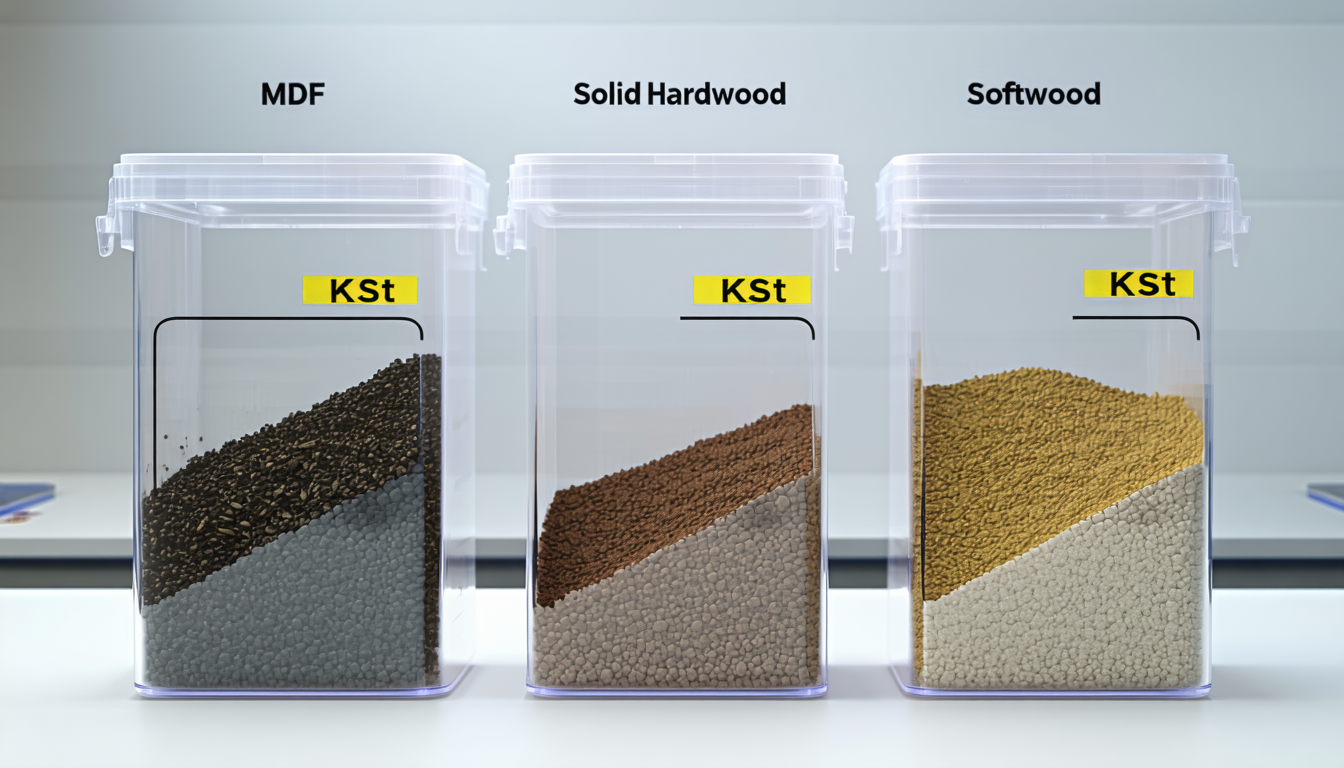
MDF dust produces higher Kst values than solid wood due to formaldehyde resin content that increases particle reactivity:
| Material Type | Typical Kst Range | Explosion Class |
|---|---|---|
| Solid hardwood | 150-200 bar-m/s | St-1 |
| Solid softwood | 120-180 bar-m/s | St-1 |
| MDF/Particle board | 200-280 bar-m/s | St-1 to St-2 |
| OSB/Plywood | 180-240 bar-m/s | St-1 |
Resin binders in engineered products create material Kst profiles that require more robust explosion protection systems. The formaldehyde and phenolic resins burn faster than wood cellulose, increasing both flame speed and pressure rise rates.
Particle size differences compound the problem. MDF processing generates more uniform fine particles than solid wood operations. The consistent particle size distribution creates optimal suspension characteristics for explosion propagation.
Testing requirements become critical for shops processing mixed wood waste streams. You cannot assume solid wood test results apply to engineered product dust. Each material type needs separate combustibility testing to determine actual Kst values.
Moisture content affects explosion severity differently in engineered products. Solid wood dust becomes less explosive as moisture increases, but resin-bonded materials maintain reactivity at higher moisture levels because the binder chemistry remains active.
Frequently Asked Questions
Does NFPA 660 apply to small woodworking shops under 5000 square feet?
Small woodworking facilities under 5,000 square feet follow NFPA 660 Chapter 25 general requirements instead of Chapter 24 woodworking-specific provisions. However, they still must comply with dust hazard analysis, housekeeping, and explosion protection requirements if they generate combustible wood dust.
Can you use plastic ductwork for wood dust if it’s not PVC?
NFPA 660 prohibits all non-conductive ductwork materials for combustible dust, not just PVC specifically. Polyethylene, polypropylene, and other plastic ductwork materials also generate static electricity during dust transport and are prohibited for wood dust collection systems.
What makes plywood and OSB dust more dangerous than solid wood dust?
Engineered wood products like plywood and OSB contain adhesive resins that increase dust reactivity and explosion severity. The formaldehyde and phenolic resins used in these products can increase Kst values by 25-40% compared to solid wood dust from the same species.