
Combustible dust training records are missing from your facility documentation, and that insurance audit letter specifically asked for proof your program meets NFPA 660 requirements. You need to build a compliant training program fast.
Key Takeaways:
- NFPA 660 requires both general awareness training for all workers and job-specific training for employees handling combustible dust operations
- Training records must document specific topics covered, not just attendance, Section 8.3.4 requires proof that each trainee understands the material
- Contractors and temporary workers need the same training level as permanent employees before starting work in areas with combustible dust hazards
What Combustible Dust Training Does NFPA 660 Actually Require?
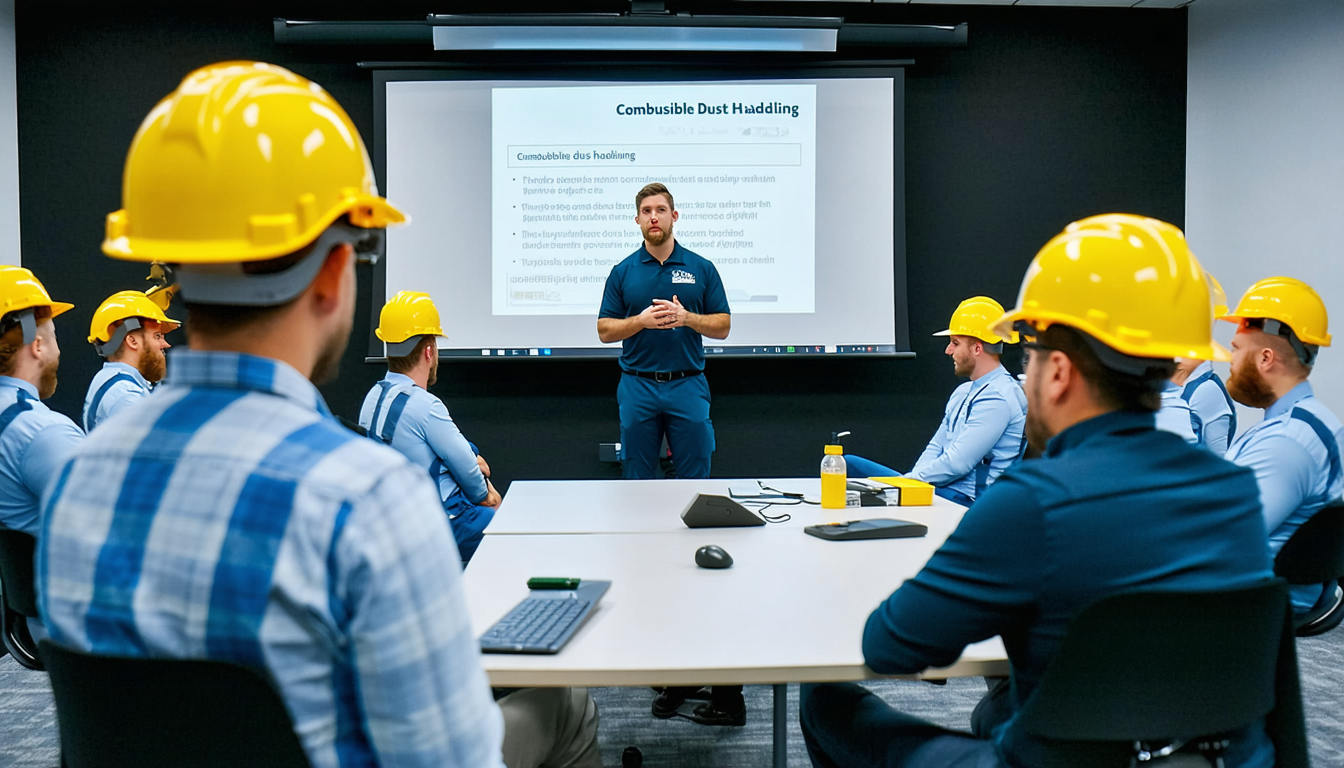
Combustible dust training is a two-tier system mandated by NFPA 660 Section 8.3. This means your facility needs both general awareness training for everyone and specialized operational training for workers who handle dust-generating processes.
NFPA 660 Section 8.3 mandates combustible dust training programs that distinguish between awareness and operational requirements. Section 8.3.1 requires general awareness training for all employees who work in areas where combustible dust is present. This covers basic hazard recognition and emergency response procedures.
General awareness training teaches workers to identify dust accumulation hazards, understand ignition sources, and know when to report dangerous conditions. Every employee who enters production areas needs this baseline knowledge, even if they never touch dust-generating equipment.
Job-specific training goes deeper. Operations personnel who work directly with combustible materials need additional instruction on safe handling procedures, equipment operation protocols, and specific emergency responses for their work area. Section 8.3.2 requires this operational training before employees begin any work involving combustible dust processes.
The standard draws a clear line between these two training levels because exposure risk varies dramatically across job functions. A maintenance worker who occasionally enters the production floor needs different knowledge than an operator who runs dust-generating equipment eight hours daily.
Who Must Receive Combustible Dust Training in Your Facility?

All facility personnel must receive appropriate level of combustible dust training based on their exposure to hazardous areas. NFPA 660 contains no exemptions for contractors, temporary workers, or short-term personnel.
| Worker Category | Training Level Required | Before Work Begins |
|---|---|---|
| Production operators | Job-specific + general awareness | Yes – full certification required |
| Maintenance personnel | Job-specific + general awareness | Yes – must complete before entry |
| Contractors | Same as permanent employees | Yes – no work until trained |
| Temporary workers | Based on assigned work area | Yes – equal to permanent staff |
| Office staff entering production | General awareness only | Yes – before area access |
| Cleaning crews | General awareness + specific procedures | Yes – before starting duties |
Contractors must receive training before beginning work, Section 8.3.2 contains no exemption for temporary personnel. Your facility bears responsibility for ensuring every contractor and temporary worker receives the same training level as permanent employees doing identical work.
Maintenance personnel need job-specific training because they work throughout the facility, often in confined spaces where dust accumulation creates the highest explosion risk. They encounter different hazards than production operators and need specialized knowledge about lockout procedures, hot work permits, and equipment cleaning protocols.
Management personnel who regularly walk production floors need general awareness training. The standard applies to anyone who works in areas with combustible dust hazards, regardless of their primary job function or how briefly they enter hazardous zones.
Required Training Topics: What Your Program Must Cover
NFPA 660 Section 8.3.3 specifies mandatory training topic requirements that every compliant program must address. Section 8.3.3 lists 7 mandatory general awareness topics plus additional job-specific requirements for operations personnel.
Your training program must cover these mandatory topics:
Dust explosion pentagon fundamentals, Workers must understand all five elements required for a dust explosion and how removing any element prevents ignition.
Hazard recognition and dust accumulation thresholds, Employees need to identify when dust accumulation exceeds safe limits and know reporting procedures.
Housekeeping program requirements and procedures, Training must cover your facility’s specific cleaning methods, schedules, and responsibilities for maintaining safe dust levels.
Ignition source identification and control, Workers must recognize static electricity, hot surfaces, mechanical sparks, and other ignition hazards in their work areas.
Emergency response procedures, Training must include evacuation routes, alarm systems, and specific actions to take if a dust explosion occurs.
Personal protective equipment requirements, Employees need to know what PPE prevents static buildup and when specialized equipment is required.
Job-specific operational procedures, Operations personnel need additional training on safe material handling, equipment operation, and process-specific safety protocols.
General awareness training covers the first six topics for all employees. Operations personnel who handle combustible materials need the seventh topic with detailed procedures specific to their equipment and processes.
Training content must connect to your facility’s dust hazard analysis findings. Generic training fails compliance if it doesn’t address the specific combustible dust hazards present in your workplace.
How Often Must You Conduct Combustible Dust Training?

Training frequency requirements vary by employee job function and facility changes. Annual refresher training is required for all personnel, with additional retraining when processes or materials change.
Initial training must occur before employees begin work in areas with combustible dust hazards. You cannot allow untrained workers to enter production areas, even for brief periods or under supervision.
Annual refresher training maintains competency for all trained personnel. This requirement applies to both general awareness and job-specific training categories. Workers who complete initial training in January need refresher training by the following January.
Retraining triggers include process changes, new equipment installation, material changes, or incident investigations that reveal training gaps. Any modification that affects combustible dust hazards requires immediate retraining for affected employees.
Facility changes that require retraining include new dust-generating equipment, modified housekeeping procedures, different ignition control measures, or changes to emergency response protocols. The training must occur before implementing the changes, not after.
Documentation timeline requirements extend beyond the training event itself. Records must show when retraining was completed and prove that employees understood the new information before resuming normal work duties.
Training Documentation: What Records You Must Keep

Training documentation must demonstrate employee competency and understanding beyond simple attendance tracking. Section 8.3.4 requires documentation proving each trainee understands the material, attendance sheets alone fail compliance.
Follow these documentation steps to satisfy OSHA inspection requirements:
Record specific topics covered in each training session, Document which of the seven mandatory topics were addressed and the time spent on each subject area.
Document competency verification for every trainee, Include test results, demonstration checklists, or other proof that employees understand the material, not just that they attended.
Maintain individual training files for each employee, Store records showing initial training, annual refreshers, and any retraining triggered by facility changes or incidents.
Keep trainer qualifications and credentials on file, Document that instructors have the knowledge and experience to deliver effective combustible dust training.
Retain records for the duration of employment plus three years, OSHA requires training records to remain available for inspection even after employees leave.
Update documentation immediately when training occurs, Records must be current and reflect the most recent training completed by each employee.
Competency verification requires more than signatures on attendance sheets. Employees must demonstrate understanding through testing, practical exercises, or structured discussions that prove they can apply the knowledge to their specific work situations.
How to Build an Effective Combustible Dust Training Program

Effective training programs combine facility-specific hazards with NFPA requirements to create instruction that addresses your actual workplace conditions. Training content must reflect the specific combustible dust hazards identified in your facility’s dust hazard analysis.
Start your program design with your dust hazard analysis results. The DHA identifies which areas have combustible dust hazards, what ignition sources exist, and where employees face the highest risk. Your training curriculum must address these specific findings, not generic combustible dust concepts.
Customize generic training materials to reflect your facility’s actual conditions. If your DHA found static electricity hazards in a specific work area, your training must explain how workers in that area prevent static buildup. Generic warnings about static electricity miss the target.
Competency assessment methods must prove understanding, not just completion. Written tests work for general awareness topics, but job-specific training requires hands-on demonstration. Employees must show they can perform safe procedures, not just recite them.
Training delivery should match your workforce. Some facilities need bilingual instruction, others require different literacy levels, and shift schedules affect when training can occur. Design your program around employee needs while maintaining NFPA compliance.
Program effectiveness depends on connecting training content to daily work activities. Employees retain information better when they see immediate application to their job duties. Abstract safety concepts fail compared to specific procedures they use every shift.
Frequently Asked Questions
Can I use online combustible dust training to meet NFPA requirements?
Online training can cover general awareness topics required by NFPA 660, but job-specific training for operations personnel typically requires hands-on demonstration of procedures. Your training method must prove employee competency, not just completion.
Do office workers need combustible dust training if they don’t work in production areas?
Office workers need general awareness training if they regularly enter areas where combustible dust is present, such as walking through production floors. NFPA 660 Section 8.3.1 applies to anyone who works in areas with dust hazards, regardless of their primary job function.
What happens if an employee fails the combustible dust training competency test?
Employees who fail competency testing cannot work in areas with combustible dust hazards until they successfully complete retraining and pass the assessment. Section 8.3.4 requires documented proof of understanding before allowing work to begin.