
NFPA 660 combustible dust standards replaced six separate regulations on December 31, 2024. This consolidation created a single compliance framework that forces thousands of facilities to update their documentation and understand new enforcement patterns.
Key Takeaways:
- NFPA 660 consolidated NFPA 652, 654, 655, 656, 659, and 664 into one standard effective December 31, 2024
- Existing Dust Hazard Analysis documentation must be updated by the next review cycle to reference NFPA 660 chapter numbers instead of old standard sections
- Authority having jurisdiction enforcement shifted from multiple standards to NFPA 660’s unified structure, affecting permit applications and inspection citations
What Is NFPA 660 and When Did It Take Effect?
NFPA 660 is the consolidated combustible dust standard that replaced six predecessor standards on December 31, 2024. This means facilities previously juggling requirements across multiple NFPA documents now work with one unified code.
The National Fire Protection Association created this consolidation to eliminate contradictions between standards and reduce confusion for authority having jurisdiction enforcement. NFPA 652 served as the general standard while industry-specific codes like NFPA 654 (metalworking) and NFPA 664 (wood processing) created overlapping requirements that often conflicted.
Six separate standards merged into NFPA 660: NFPA 652 (general requirements), NFPA 654 (chemical and petrochemical), NFPA 655 (sulfur), NFPA 656 (food and beverage), NFPA 659 (combustible dusts in classification of areas), and NFPA 664 (wood processing). Each standard’s core requirements transferred to specific chapters within NFPA 660, maintaining technical content while organizing it under one document.
The effective date applies to all new construction, major modifications, and documentation updates initiated after December 31, 2024. Existing facilities operate under their current documentation until the next scheduled review cycle, typically within five years of their last assessment.
What Changed From NFPA 652 to NFPA 660: Section-by-Section Mapping
NFPA 652 sections mapped directly to NFPA 660 chapters with minimal technical changes. The consolidation focused on organization rather than rewriting requirements.
| NFPA 652 Section | NFPA 660 Chapter | Requirement Type |
|---|---|---|
| Section 7.1 (DHA Requirements) | Chapter 7 | Dust Hazard Analysis procedures |
| Section 8.0 (Hazardous Area Classification) | Chapter 8 | Electrical equipment classification |
| Section 9.0 (Fire Prevention) | Chapter 9 | Ignition source control |
| Section 10.0 (Housekeeping) | Chapter 10 | Dust accumulation limits |
| Section 11.0 (Management Systems) | Chapter 11 | Written programs and training |
NFPA 652 Section 7.1 moved to NFPA 660 Chapter 7 with identical language requiring facilities to conduct and document Dust Hazard Analysis within the scope of combustible dust operations. The five-year review cycle requirement stayed the same.
Hazardous area classification requirements from NFPA 652 Section 8.0 transferred to NFPA 660 Chapter 8 without modification. Facilities still use the same electrical equipment classification zones based on dust layer thickness and dispersion potential.
Ignition source control and housekeeping requirements maintained their technical specifications. Hot work permit procedures, preventive maintenance schedules, and dust accumulation thickness limits of 1/32 inch carried forward unchanged.
The biggest organizational change moved industry-specific modifications from separate standards into NFPA 660 chapters 21-25. These chapters reference the general requirements in chapters 1-20 while adding industry-specific clarifications for metalworking, wood processing, food manufacturing, and pharmaceutical operations.
NFPA 660 Chapter Structure: How Industry-Specific Requirements Are Organized
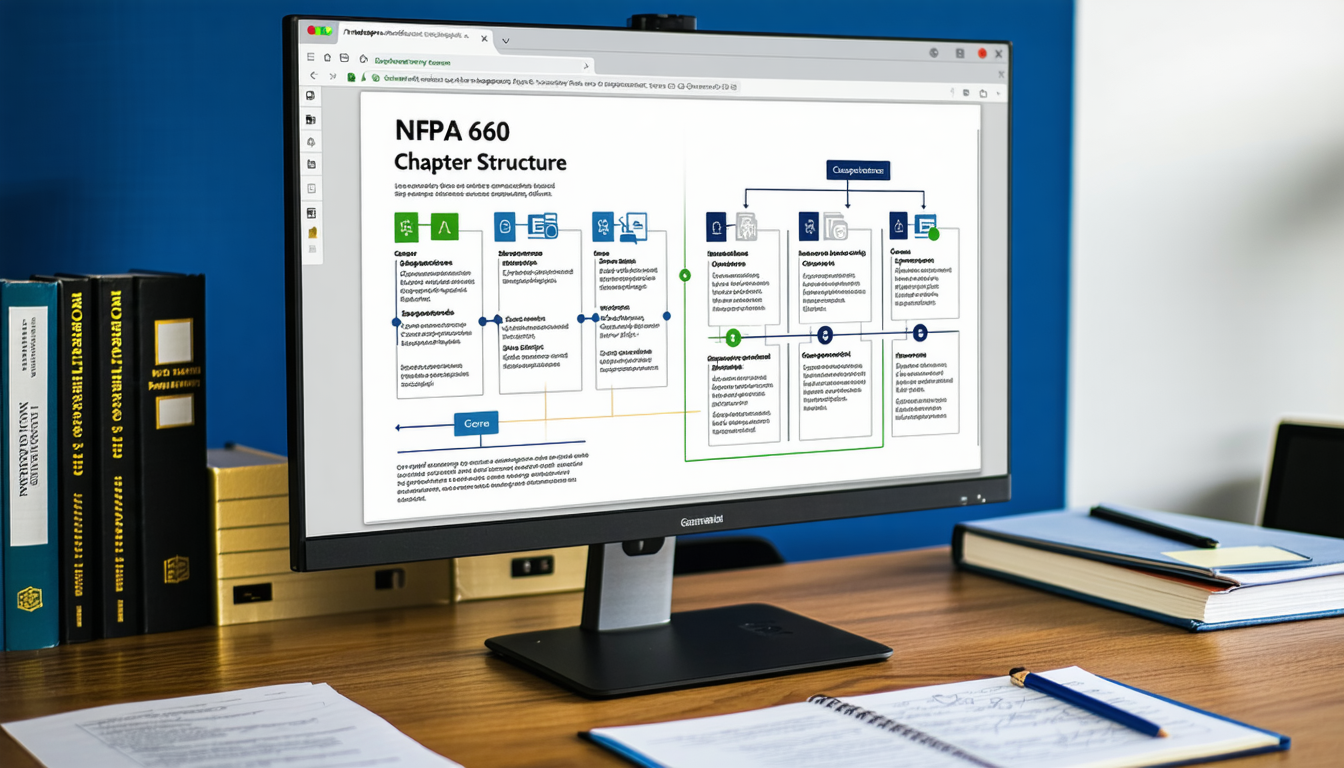
NFPA 660 organizes requirements into general chapters (1-20) that apply to all facilities, followed by industry-specific chapters (21-25) that modify general requirements for particular sectors.
The chapter structure includes:
- Chapters 1-6: Administrative requirements including scope, definitions, and referenced publications that establish the standard’s authority and terminology
- Chapters 7-11: Core technical requirements for Dust Hazard Analysis, hazardous area classification, fire prevention, housekeeping, and management systems that apply across all industries
- Chapters 12-20: Equipment-specific requirements for dust collection systems, pneumatic conveying, and processing equipment that handle combustible dust in any industry
- Chapters 21-25: Industry-specific modifications for agricultural commodities, metalworking, wood processing, food and beverage, and pharmaceutical manufacturing
- Annexes A-J: Non-mandatory guidance explaining technical concepts, providing calculation methods, and offering implementation examples
Chapters 21-25 contain industry-specific modifications to the general requirements in Chapters 1-20. For example, Chapter 23 (wood processing) references the general housekeeping requirements in Chapter 10 but adds specific provisions for wood dust in concealed spaces and requirements for pneumatic waste removal systems.
Facilities determine their applicable chapters by identifying their primary combustible dust operations. A furniture manufacturer follows Chapters 1-20 plus Chapter 23. A food processing plant uses Chapters 1-20 plus Chapter 24. Multi-industry facilities must comply with all applicable industry chapters.
Do I Need to Update My DHA for NFPA 660?

Existing DHA documentation requires NFPA 660 citation updates by the next scheduled review cycle. The technical assessment content stays valid, but section references must point to the new standard.
Follow these steps to update your DHA documentation:
- Review your current DHA completion date – facilities with DHAs completed within the last five years can wait until their next scheduled review to update citations, while those approaching their five-year deadline should incorporate NFPA 660 references during the review process
- Map old citations to new chapters – replace NFPA 652 section references with equivalent NFPA 660 chapter numbers using the section-by-section mapping, ensuring all technical requirements remain covered under the new citation structure
- Update industry-specific requirements – facilities previously following both NFPA 652 and an industry standard (like NFPA 664) now reference the general chapters plus their applicable industry chapter within NFPA 660
- Submit updated documentation to your authority having jurisdiction – fire marshals, insurance carriers, and OSHA inspectors expect NFPA 660 citations in all new submissions starting January 1, 2025
DHA documentation must be updated by the next scheduled review cycle, typically within 5 years of the facility’s last assessment. Facilities approaching their review deadline should incorporate NFPA 660 references during the update process rather than conducting separate citation updates.
Authority having jurisdiction expectations vary by location. Some fire departments accept existing documentation with old citations until the next formal review, while others require updated references for permit renewals or modification approvals starting in 2025.
How Does OSHA NEP Enforcement Change Under NFPA 660?

OSHA NEP inspectors now cite NFPA 660 sections instead of referencing multiple standards during combustible dust inspections. This streamlines violation documentation but maintains the same General Duty Clause enforcement approach.
| Enforcement Element | Pre-2025 Approach | NFPA 660 Approach | Impact |
|---|---|---|---|
| Citation Structure | Referenced NFPA 652 + industry standard | Single NFPA 660 chapter reference | Simplified violation documentation |
| General Duty Clause | Multiple standard recognition | NFPA 660 as recognized industry practice | Same legal weight, cleaner citations |
| Inspector Training | Knowledge of 6 separate standards | Focus on unified NFPA 660 structure | More consistent enforcement |
| Violation Categories | Cross-referenced multiple documents | Single standard reference points | Reduced citation complexity |
OSHA NEP inspectors now reference NFPA 660 sections instead of juggling citations across six different standards. For example, inadequate housekeeping violations previously cited both NFPA 652 Section 10.0 and relevant industry standard sections. Now inspectors reference NFPA 660 Chapter 10 plus the applicable industry chapter.
General Duty Clause enforcement maintains the same legal framework under NFPA 660. OSHA recognizes the consolidated standard as accepted industry practice for combustible dust safety, giving citations the same regulatory weight as before consolidation.
The change benefits both inspectors and facility operators by eliminating confusion about which standard takes precedence when requirements appeared to conflict between NFPA 652 and industry-specific codes.
What Documentation Must Change by Your Next Authority Review?

Facility documentation must reference NFPA 660 chapters instead of old standard sections for all submissions to authority having jurisdiction starting January 1, 2025.
Update these specific documents:
- Written combustible dust programs – replace all NFPA 652 section references with equivalent NFPA 660 chapter numbers, ensuring procedures still address the same technical requirements under the new citation structure
- Fire marshal permit applications – new construction, modifications, and permit renewals must cite NFPA 660 chapters for dust collection systems, electrical classifications, and fire protection measures
- Insurance audit documentation – carriers expect NFPA 660 references in risk assessments, compliance certificates, and loss prevention program documentation submitted after January 2025
- Hot work permit procedures – update ignition source control references from NFPA 652 Section 9.0 to NFPA 660 Chapter 9 while maintaining the same technical safety measures
- Contractor safety requirements – specifications for maintenance work, equipment installation, and facility modifications must reference current NFPA 660 chapters rather than outdated standard sections
- Emergency response plans – coordinate with local fire departments to ensure response procedures reference the authority having jurisdiction’s NFPA 660 enforcement approach
Fire marshal permit applications and insurance audit documentation must reference NFPA 660 chapters starting January 1, 2025. Submissions with outdated citations may face delays while authority having jurisdiction staff request updated references.
Timeline requirements vary by document type. Safety programs and internal procedures can update during normal review cycles, while permit applications and regulatory submissions need immediate NFPA 660 compliance for processing.
Frequently Asked Questions
Can I still use my old NFPA 652 documentation after December 2024?
Existing NFPA 652-based documentation remains valid until your next scheduled review cycle. Authority having jurisdiction typically requires updated citations to NFPA 660 within the normal 5-year DHA review period, not immediately.
Which facilities are exempt from NFPA 660 requirements?
NFPA 660 applies to all facilities that handle combustible dust, with no industry exemptions. However, facilities with only non-combustible dusts or those below the dust accumulation thresholds specified in Chapter 4 may not need full compliance.
How much does it cost to update existing documentation for NFPA 660?
Documentation updates typically cost $2,000-$5,000 for citation changes and cross-referencing if you use existing consultants. The work involves updating section references, not rewriting entire assessments, since the technical requirements stayed the same.